
Insights · · By Cald
How to Choose an All-in-One Marketing Tool for Your App
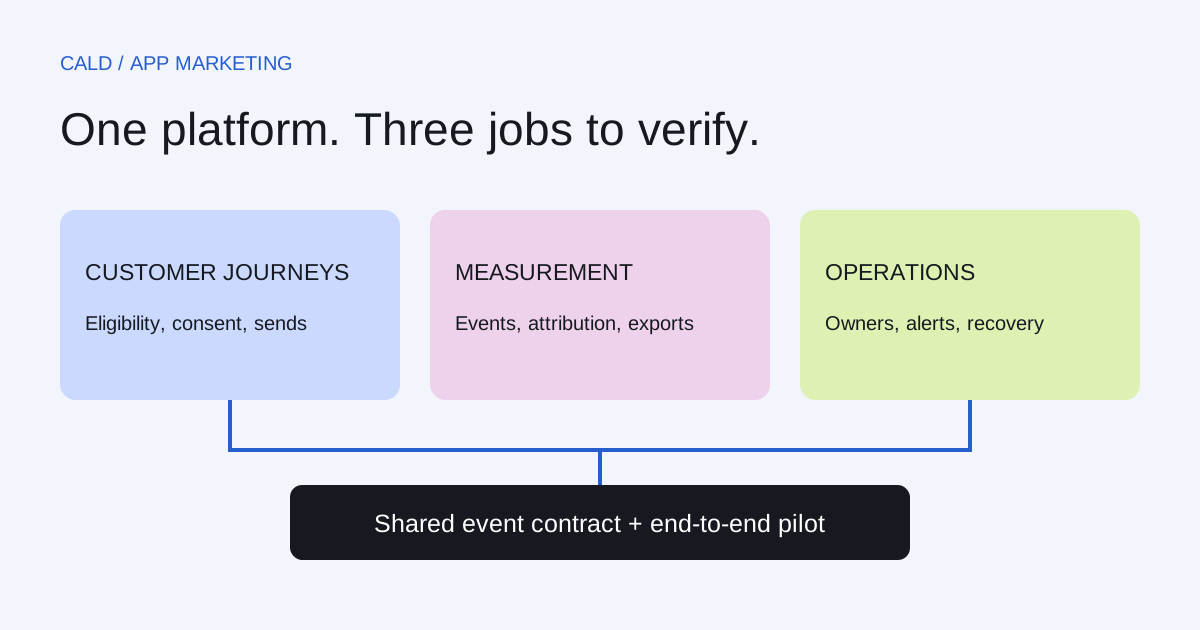
The best all-in-one marketing tool for your app is the one that covers your most important workflow without creating an unmanageable integration gap. Start with the decision you need to make, the customer journey you need to run and the data needed to support both. Buying a broad platform does not remove responsibility for identity, consent, event definitions or delivery verification.
This guide offers a selection method rather than a universal vendor ranking. It separates lifecycle messaging, acquisition measurement and customer records, then shows how to test whether one platform covers enough of your needs.
Download the platform evaluation worksheet →
1. Define what “all-in-one” needs to mean
A sales-led app may need a shared contact record, lead follow-up and account history. A consumer subscription app may prioritize onboarding, push messages, purchase suppression and retention cohorts. A paid acquisition team also needs to understand which campaigns receive credit for installs and purchases. These are related requirements, but they are different jobs.
| Job | Evidence to request | Common boundary to inspect |
|---|---|---|
| Customer records and lead follow-up | A record moving from enquiry to qualified customer with the correct owner | App identities and billing records may need a separate mapping |
| Lifecycle messaging | An eligible user receives the intended message and a suppressed user does not | SDK integration, channel setup and consent remain implementation work |
| Acquisition measurement | A test journey with documented attribution settings and exportable outcomes | A campaign engagement report may not answer mobile attribution questions |
| Reporting and operations | Event reconciliation, useful exports and a failed-delivery investigation | Retention, latency, permissions and contract limits can constrain the workflow |
Write five must-have outcomes and mark each as native, integration-dependent, custom-built or unavailable. “Available through an integration” is a useful answer only after you know who builds it, what data it shares and how failures are handled.
2. Read product documentation against your workflow
HubSpot documents custom events that can feed reporting, contact timelines and workflows, with availability and ingestion methods depending on the subscription. Its documentation lists API ingestion, spreadsheet upload and webhooks, with specific requirements for webhooks. Confirm the methods and tier your proposed solution actually uses. Read HubSpot’s custom event documentation.
Braze’s integration overview describes SDK and API work, channel configuration, QA and ongoing maintenance. It also separates campaign planning from data requirements. That is a useful reminder that a messaging platform still needs a defined event taxonomy and verified data flow. Read Braze’s integration overview.
Separate tools can also have a documented handoff. Adjust’s Braze integration sends measured data through callbacks and exposes sharing and parameter-mapping choices. The existence of the connector does not settle your event definitions or permitted fields. Read the Adjust to Braze integration guide.
These examples illustrate evaluation boundaries, not an exclusive capability claim or an endorsement. For a product-led lifecycle shortlist, use the CRM comparison hub. For campaign attribution requirements, use the MMP comparison hub.
3. Run a small end-to-end pilot
Hypothetical example: a subscription app needs to welcome a new user, remind an inactive trial user and stop trial messaging after a successful first payment. Its existing backend already records account creation and billing outcomes. The team wants to know whether a proposed platform can operate that journey reliably.
Define three business events before connecting anything: Account Created fires after the backend saves the account; Core Action Completed fires after the app’s chosen activation action succeeds; First Payment Settled fires from the billing system only after the first successful payment. A button click, failed payment or renewal is not the first settled payment.
Give each event an event ID, occurrence time, environment and appropriate stable account identifier. Document the source of truth and destination requirements in a tracking plan. Keep raw payment credentials and unnecessary personal fields out of marketing payloads.
- Eligible new user: confirm the profile and welcome eligibility appear within the team’s agreed operating window.
- Unsubscribed user: confirm the relevant channel’s suppression behavior before attempting a send.
- Paying user: verify that a settled payment removes trial-reminder eligibility, including when the event arrives late.
- Retried event: resend the same event ID and check whether the proposed integration avoids duplicated outcomes or sends.
- Anonymous-to-known journey: inspect the identity transition and ensure that a second profile does not receive a conflicting journey.
- Delivery failure: break a staging destination deliberately and confirm the alert, investigation record and recovery owner.
Choose an acceptable latency for each use case. A nightly export may support tomorrow’s report while failing a time-sensitive suppression requirement. Record observed behavior rather than accepting “real time” as a complete specification.
4. Compare total operating cost
Ask for a quote using the same expected users, events, channels, seats and exports. Include implementation, data cleanup, content production, support, recurring administration and exit work. Check what happens when volume exceeds the included allowance and whether the required export or integration is an add-on.
Synthetic decision example: suppose option A costs $900 per month in software and needs 12 operating hours at an assumed $50 per hour. Its illustrative recurring cost is $1,500. Option B costs $600 in software but needs 22 hours at that same assumption, giving $1,700. Neither figure is a vendor quote or market benchmark. This simply shows why a cheaper subscription can have a higher operating cost.
Compare setup costs separately and include them in the chosen evaluation horizon. Do not infer marketing ROI from software savings alone. Acquisition contribution, retention and campaign outcomes require their own evidence. The app marketing budget guide helps place the platform in the larger spending plan.
5. Keep ownership explicit after the purchase
Maintain a versioned event contract and a catalog with synthetic screenshots showing the user action and actual emission point. Use CODEOWNERS for the integration and event-schema files so Martech reviews relevant changes. Add CI checks for required properties and allowed payload fields. File ownership does not automatically detect every tracking call elsewhere in the codebase.
Use destination-specific field allowlists, consent tests and separate staging credentials. Monitor each enabled channel and source-to-destination path, including SDK delivery, backend events and warehouse exports. A healthy aggregate count can hide a broken push channel or a missing payment feed.
Assign owners for expired credentials, duplicate records, failed deliveries and suppression errors. Test a recovery path that does not replay unwanted messages. Before signing, also confirm how to export customer identifiers, event history, consent records and suppression data, and what work is needed to rebuild active journeys elsewhere.
Make the choice with a pass/fail sheet
Reject a candidate if it cannot satisfy a must-have journey, data-control requirement or recovery test. Among the candidates that pass, compare implementation burden and total cost over the same horizon. Prefer one platform when it covers the critical workflow with manageable boundaries. Add a specialist tool when a demonstrated gap justifies the additional integration.
Cald helps define the contracts and connect the sources behind these workflows. Review our CRM integration service when you need to turn a shortlist into a tested implementation scope.
Related articles
- Compare CRM platforms: Build a lifecycle shortlist around workflow and architecture.
- Compare mobile measurement partners: Evaluate attribution requirements separately.
- Build an implementable tracking plan: Define event triggers and acceptance checks.