
CRM comparison · · By Cald
CRM Platform Comparison: Seven Customer Engagement Tools
A practical shortlist for lifecycle teams choosing customer data, journeys, messaging and agentic capabilities.
Take the six-question CRM quiz ↓ · Related articles ↓
Official documentation checked November 3, 2026. These are Cald’s editorial evaluation guides, not controlled product benchmarks. Confirm availability, regional support, limits and commercial terms in the account and package you would buy.
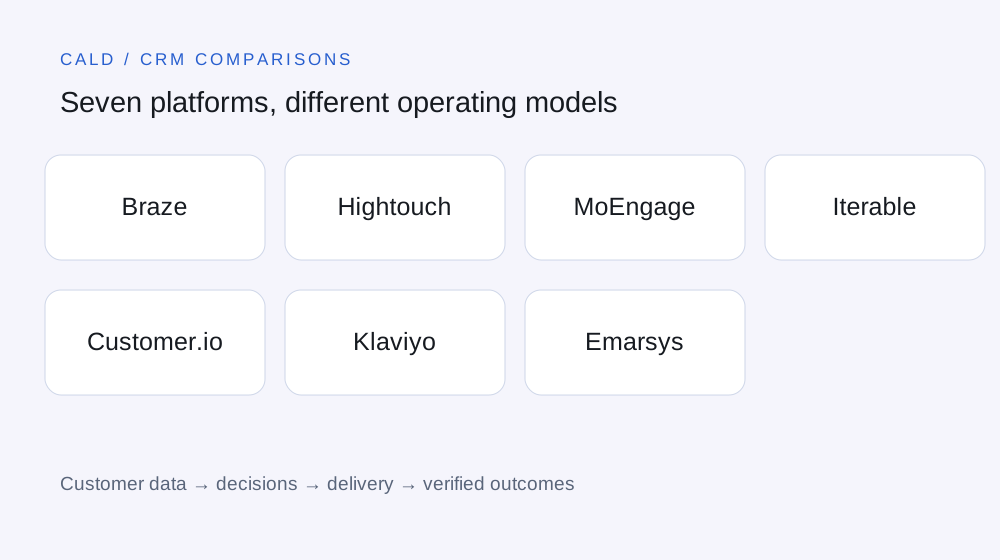
Choose the operating model before the platform. Braze, MoEngage, Iterable, Customer.io, Klaviyo and Emarsys / SAP Engagement Cloud all belong in customer engagement evaluations. Hightouch can supply data activation and decisioning alongside a retained sender. This guide uses CRM in the B2C lifecycle sense; it is not a sales-pipeline CRM ranking.
This guide focuses on seven customer engagement and activation platforms. The recommendations below are editorial starting points, not claims of exclusive features. A candidate outside a row’s suggested starting point may still pass your requirements.
Seven platforms: what to prove first
| Platform | Documented starting point | Prove in your account |
|---|---|---|
| Braze | Engagement and Canvas orchestration | Native decisioning; separate Go from Pro |
| Hightouch | Data activation and a decision layer connected to messaging tools | Warehouse feedback and agent guardrails |
| MoEngage | Customer engagement, analytics and Flows | Merlin agents and separately scoped decisioning |
| Iterable | Campaigns and cross-channel journeys | Nova assistance and journey execution controls |
| Customer.io | Data-triggered customer messaging | Built-in Agent and permissioned MCP access |
| Klaviyo | B2C marketing, commerce data and flows | Composer creates and audits work with approval |
| Emarsys / SAP Engagement Cloud | Enterprise engagement connected to SAP business data | Joule and operational-data activation |
SAP’s current product page explicitly identifies Engagement Cloud as formerly SAP Emarsys. Hightouch’s decisioning documentation describes delivery through connected tools. These distinctions affect both the architecture and the quote.
Separate four kinds of AI work
| Job | What to demonstrate | Evidence |
|---|---|---|
| Authoring and analysis | An assistant drafts a campaign or investigates a metric. | Approved diff, sources used and the operator who publishes. |
| Workflow execution | An agent creates or changes campaign resources. | Read/write permissions, review boundary, logs and rollback. |
| Predictive optimization | A model predicts propensity, channel or send timing. | Model objective, eligibility rules and a test of scheduled actions. |
| Adaptive decisioning | A policy chooses among approved treatments using feedback. | Business goal, action set, guardrails, holdout and trustworthy outcomes. |
Use the agentic CRM comparison to compare the documented AI jobs across the seven brands. A workflow assistant is not automatically a customer-level decision engine, and a decision engine does not remove the need for consent or channel operations.
Six head-to-head guides
- Braze vs Hightouch: Warehouse-led win-back.
- Braze vs MoEngage: App activation with channel fallback.
- Braze vs Iterable: Renewal reminder with a late payment.
- Braze vs Customer.io: Workspace activation with one accountable recipient.
- Braze vs Klaviyo: Abandoned checkout after an order.
- Braze vs Emarsys: Back-in-stock messaging with operational data.
Worked example: choose a stack for a subscription app
Synthetic brief. A product team has billing data, web and app events, and an existing sender. It wants to increase first paid activations while reducing irrelevant reminders. Before replacing anything, separate the source of truth, audience computation, treatment selection, journey orchestration and channel delivery. Put an owner and a freshness expectation next to each connection.
Define trial_started as a backend-created trial with customer_id, trial_id, started_at and event_id. Define first_payment_settled as the first successful charge for that trial, excluding retries and renewals. An account with no current marketing permission is ineligible, even if its trial is ending.
A deterministic journey, a native decisioning product and an external decision layer are three testable designs. Send the same synthetic events through each proposed design. Verify arrival time, entry, deliberate non-sends and the payment stop condition. Replacing the sender is justified only if the required experience or operations cannot be met with the retained architecture.
Price the architecture, not seven entry tiers
Write one workload: monthly active audience, total retained profiles, object records, email volume, mobile and other channel volume, regions, brands, environments, exports, AI actions and support. Ask for expected usage and twice that usage. Include retained sender fees when evaluating Hightouch and operational-data integration when evaluating SAP Engagement Cloud.
Public pricing references: Braze · Hightouch · MoEngage · Customer.io · Klaviyo. Obtain scoped proposals for Iterable and SAP Engagement Cloud. Published limits and starting prices are inputs to a quote, not comparable totals.
A procurement scorecard your operators can use
- Mark required channels, consent behavior, region and data export as mandatory gates.
- Run one eligible customer, one suppressed customer, one late event and one duplicate event through the pilot.
- Have the actual lifecycle operator investigate an unexpected no-send using supported evidence.
- Rehearse stopping the journey and inspect pending delivery queues before enabling real customers.
- Score operator effort, migration cost and recurring commercial exposure only after the mandatory gates pass.
Download the CRM evaluation and pilot worksheet →
Which platform should your organization evaluate first?
Answer six questions about your workflow, existing stack, data, AI scope, team and buying gate. This quiz compares all seven platforms. It offers an editorial starting point and a pilot checklist, not a verified product ranking. A low score does not establish that a platform lacks a capability. Answers stay in this page and are not stored or submitted.
Your evaluation and pilot plan
How the quiz makes a recommendation
Questions 1–3 add the editorial points below. Questions 4–6 tailor the AI, operating and buying tasks without changing the ranking. Unlisted or undecided options add no points. On a two-platform page, points for outside brands are ignored; the result links to the full shortlist when appropriate. The highest totals share first place, including a tie at zero. Fit shares describe points, not probabilities, measured quality or feature completeness.
| Answer | Editorial points |
|---|---|
| App and web lifecycle journeys | Braze +3; MoEngage +2; Iterable +1 |
| Insight-led activation and channel fallback | MoEngage +3; Braze +1; Iterable +1 |
| Catalog-backed messages across customer journeys | Iterable +3; Braze +1; Klaviyo +1 |
| Product onboarding tied to accounts or workspaces | Customer.io +3; Braze +1; Iterable +1 |
| Commerce recovery and repeat purchases | Klaviyo +3; Emarsys / SAP Engagement Cloud +1; Braze +1 |
| Enterprise engagement connected to SAP business data | Emarsys / SAP Engagement Cloud +3 |
| Adaptive decisions from warehouse outcomes | Hightouch +3 |
| Keep the current sender; add data activation or decisioning | Hightouch +3 |
| Evaluate a primary engagement and messaging platform | Braze +1; MoEngage +1; Iterable +1; Customer.io +1; Klaviyo +1; Emarsys / SAP Engagement Cloud +1 |
| Warehouse audiences and business-outcome feedback | Hightouch +3 |
| Regional orders, inventory and SAP operational data | Emarsys / SAP Engagement Cloud +3 |
| Storefront, cart and order context | Klaviyo +3; Emarsys / SAP Engagement Cloud +1 |
| People related to accounts, workspaces or other objects | Customer.io +3 |
| Catalog items and reusable message data | Iterable +3 |
| App/web behavior and channel eligibility | Braze +2; MoEngage +2; Iterable +1 |
| AI scope, team, buying gate, new stack or undecided | No points; use the tailored pilot tasks. |
These weights express where Cald would start the evaluation; they do not assert exclusive capabilities. Mandatory requirements override the score. Hightouch may complement a retained sender. Confirm source data, channel eligibility, agent permissions, account availability and commercial terms before choosing.