
Insights · · By Cald
How Much Should You Budget for App Marketing?
Your app marketing budget should fund a decision: can you acquire customers whose contribution covers the cost of reaching and serving them? A number such as “$5,000 per month” is incomplete until you separate ad spend from creative, implementation, tools and the people running the work.
This guide shows how to scope a first acquisition test and calculate what it could teach you. All dollar amounts in the worked example are synthetic planning assumptions, not market benchmarks, vendor quotes or promised results.
Download the app marketing budget template →
1. Decide which customer outcome the budget should buy
Install volume can help assess acquisition reach, but an install is not necessarily an activated user or paying customer. Choose a primary outcome that fits your business: a first settled subscription payment, a completed first order, or a qualified application. Document the trigger, exclusions and time allowed for the outcome.
For a subscription app, define the first payment from the billing backend and distinguish it from a trial, failed payment or renewal. Use a tracking plan to connect the install, activation and payment stages. If the journey is not measurable yet, include that setup before interpreting acquisition efficiency.
2. Work backward from contribution and cash constraints
Estimate contribution per acquired customer over an explicit payback horizon. Start with collected revenue and subtract refunds, applicable platform/payment charges and variable service costs. Treat longer-term retention as an uncertain assumption until cohorts support it. Do not use lifetime revenue as if it were immediately available cash.
Illustrative unit economics: suppose a customer contributes $60 over your chosen horizon, and you decide that no more than $30 can fund acquisition. If 5% of acquired installs become paying customers, a $1.50 media cost per install implies a $30 media cost per payer: $1.50 ÷ 0.05. At a 2% payer rate, the same install cost implies $75 per payer. Cheap installs can still be uneconomic.
That calculation excludes creative, tools and operating labor. Review both media acquisition cost and fully loaded acquisition cost. Set a cash limit that you can afford to lose during the test without relying on future revenue to pay current bills.
3. Separate the costs before comparing proposals
| Cost | What to include | Question to resolve |
|---|---|---|
| Media | Platform spend for the defined audience, geography and test period. | How much can this campaign spend, including its budget behavior? |
| Creative and store assets | Copy, images, video, localization and a planned revision cycle. | Who produces replacements when a concept does not work? |
| Measurement setup | Event definitions, SDK/backend work, destination mapping and QA. | Which outcome will be verified before spend starts? |
| Tools | Attribution, analytics, messaging and required exports under the actual contract. | Which usage limits, add-ons and overages apply? |
| Operations | Internal time or external fees for reporting, creative review and investigation. | Who owns the daily checks and decisions? |
| Reserve | A deliberate allowance for approved revisions or unexpected costs. | Who can release it, and for what purpose? |
Ask whether an agency fee includes media buying, creative production, measurement engineering and platform subscriptions. Price the same deliverables before comparing totals. Cald's tracking implementation pricing describes a separate engineering scope; it is not an all-inclusive app promotion retainer.
4. Check whether the channel fits the test budget
Google's App campaign guidance recommends an average daily budget of 50 times target cost per install, or 10 times target cost per in-app action. These are campaign recommendations, not a guarantee of results or a universal minimum app marketing budget. At a hypothetical $2 target CPI, 50 times implies $100 per day in media alone. That may not fit a small test once creative and measurement are included.
Apple's budget documentation says the daily budget is an average: individual days can exceed it, while the monthly limit uses 30.4 times that budget. A hypothetical $50 daily budget therefore corresponds to $1,520 under that monthly calculation. Review the documented treatment of end dates and mid-month changes before setting a test limit.
Start with one channel and one clearly defined market when that gives the budget a useful test. Dividing a small media allowance across several platforms can leave each test too thin to interpret. If the campaign requirements do not fit your cash limit, narrow the question, improve owned/store distribution, or defer the paid test. Do not disguise an underfunded experiment as a scaling plan.
5. Build a worked first-month plan
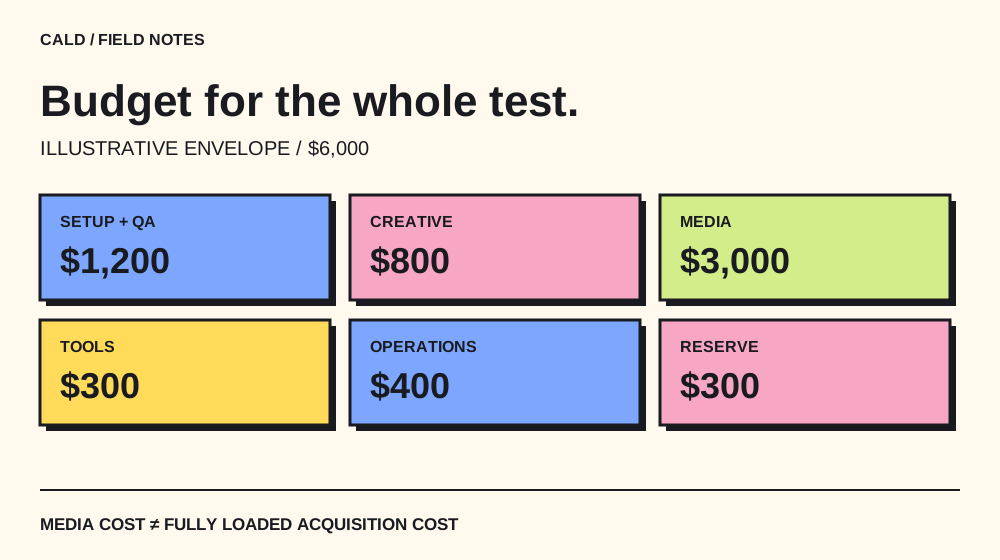
Synthetic example: an app team caps its first-month outlay at $6,000. It already has a production app and is testing one market. These allocations illustrate a planning method; they are not recommended percentages.
| Line | Amount | Acceptance condition |
|---|---|---|
| Measurement implementation and QA | $1,200 | First payment and retry tests pass at the agreed destinations. |
| Creative and store assets | $800 | Approved concepts and one revision cycle are delivered. |
| Media test | $3,000 | One channel, market and budget configuration are documented. |
| Tools | $300 | Required reporting is included in the purchased scope. |
| Operations | $400 | A named owner performs checks and records decisions. |
| Reserve | $300 | Held until a specific revision is approved. |
| Total envelope | $6,000 | Unused reserve remains unspent. |
If $3,000 in media produces 2,000 installs at a $1.50 CPI and 100 first-time payers, the media cost per payer is $30. If every budget line, including reserve, is spent, the fully loaded cost is $60 per payer. With the illustrative $60 contribution assumption, that leaves no acquisition headroom before fixed business costs. Neither the install count nor a pleasing CPI establishes profitability.
If only 40 payers emerge, media cost per payer becomes $75 and fully loaded cost becomes $150. This sensitivity matters more than choosing a fashionable budget percentage. Keep first-month setup separate from recurring months, and also calculate cumulative payback so a later month does not appear profitable only because setup costs disappeared from its view.
6. Verify the signal before drawing conclusions
- Test completed, failed and retried payments with synthetic records; ensure test events do not influence campaign optimization.
- Reconcile event counts and revenue to billing. Document time zones, cohorts, attribution windows and reporting delays before comparing tools.
- Track activation and retention alongside acquisition. A low-cost audience that never reaches the app's core value is not a scaling signal.
- Record consent and permitted identity mappings. Collect and route only the fields each destination needs.
- Assign an owner for delivery failures, duplicate counts, credential expiry and spend alerts. Platform reporting and backend outcomes are separate checkpoints.
For mobile attribution, choose the MMP shortlist around required networks, deep links and data exports. Do not buy a complex stack without a defined reporting need.
7. Set pause, revise and scale decisions in advance
Write a decision sheet before launch: hypothesis, cash cap, evaluation window, primary outcome, known delays, responsible owner and next action. Distinguish an operational stop, such as broken tracking or an incorrect destination, from a performance decision that needs a mature cohort.
For example, pause spend if payment events are duplicated or the advertised journey is broken. Review creative or onboarding if the funnel loses users before activation. Consider an additional test only when the measured outcome, contribution assumptions and cash exposure justify it. A small cohort with a few payers can swing sharply; it is not precise evidence of a stable acquisition cost.
Your useful starting budget is the amount needed to run one interpretable, affordable test, plus the work required to measure and operate it. If the full scope does not fit, reduce scope rather than hiding the missing costs.
Related articles
- How to Build a Tracking Plan Your Developers Can Implement: Define the events behind your budget decisions.
- How Much Does Server-Side Tracking Cost?: Separate implementation fees from recurring costs.
- Google App Campaigns: A Practical Setup and Measurement Checklist: Validate the campaign before spending.