
CMS comparison · · By Cald
Contentful vs Contentstack vs Strapi vs Uniform
Compare content delivery, editorial governance, backend ownership and visual composition—then build a shortlist around your team’s actual workflow.
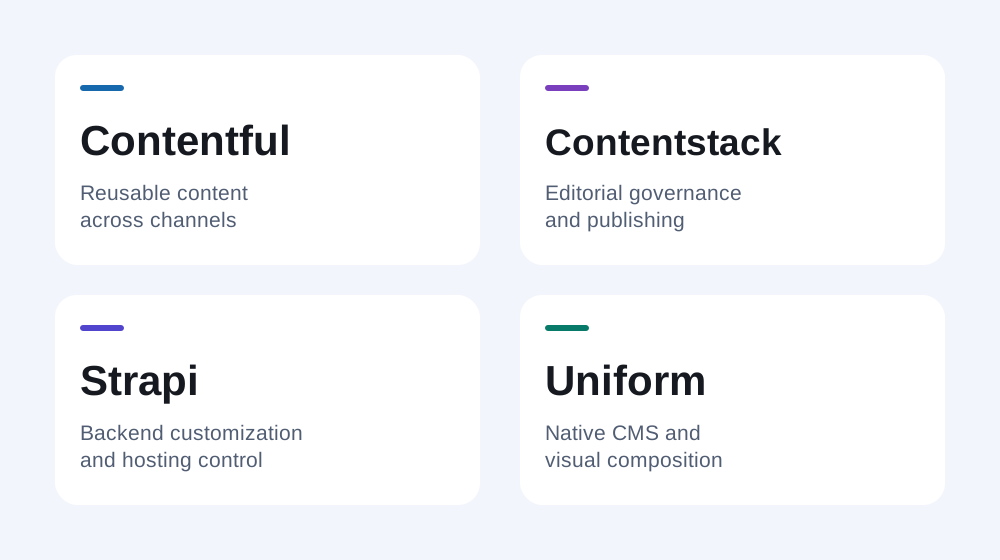
Choose the operating model before choosing the CMS. Contentful and Contentstack are managed content platforms; Strapi gives an engineering team a self-hostable CMS; Uniform combines a native CMS with visual composition and external-source integration. These are useful starting distinctions, not exclusive feature lists.
Official product documentation and public pricing pages checked October 30, 2026. Cald has not run a controlled benchmark of these platforms. Recommendations are our interpretation of the workflows below; verify feature entitlements and contract terms in the package you would buy.
Four platforms, four evaluation starting points
| Platform | Start the evaluation here | Prove this before buying |
|---|---|---|
| Contentful | Start here when the core job is designing reusable content models and delivering them to several frontends. | Model one shared promotion referenced by a website and an app. Change it once, preview both consumers and show how a schema migration is tested. |
| Contentstack | Start here when several publishing teams need clear approval paths and release responsibilities. | Have an author submit a localized campaign, a reviewer approve it, and a publisher release it to the intended environment. Attempt the same publish with an unauthorized role. |
| Strapi | Start here when an engineering team wants to own backend behavior and is prepared to maintain it. | Implement one custom validation, protect draft access, deploy a schema change and restore a backup in a disposable environment. Name the engineer who owns upgrades. |
| Uniform | Start here when marketers need to compose experiences from several systems, or want content and composition in one workspace. | Build a campaign from an approved component library using one native entry and one external data source. Preview a source update and test unavailable-source behavior. |
Uniform is included as a headless CMS because its current documentation explicitly describes native structured content. It can also sit alongside another CMS. If the content repository already works, test an overlay before assuming a migration is necessary.
Specifications that matter beyond a feature checklist
| Requirement | Contentful | Contentstack | Strapi | Uniform |
|---|---|---|---|---|
| Operating model | Managed content platform | Managed content platform | Open-source CMS; self-host or use Strapi Cloud | Composable DXP with a built-in headless CMS |
| Content structure | Spaces contain content types and entries; reference fields connect reusable records. Docs. | Branches let teams work with copies of stack content; publishing environments define delivery targets. Docs. | Collection types, single types and components define structured content; the Content-type Builder is available in development. Docs. | Uniform includes native content types and entries; Mesh also connects external content and commerce systems. Docs. |
| Preview | Preview uses the Content Preview API and a configured frontend URL; live preview needs frontend integration. Docs. | Live Preview requires environment URLs, preview configuration and a preview-aware frontend. Docs. | Preview needs a configured frontend handler. Confirm the entitlement for the live-preview experience separately. Docs. | Canvas composes experiences from developer-registered components; the frontend must implement those components. Docs. |
| Release workflow | Sandbox environments and aliases support testing content-model changes before switching consumers. Docs. | Workflows define stages and publishing approval conditions, with branch-specific configuration. Docs. | Draft & Publish separates unpublished changes from live content and is enabled per content type. Docs. | The CMS documentation describes workflows, localization, releases and scheduling alongside native content. Docs. |
A CMS preview is part of an application architecture. Require the preview to use the intended locale, draft revision and referenced records, while public requests continue to use published content. Developers still own frontend rendering, protected preview access and cache behavior.
Pricing: compare the whole implementation
Contentful: Compare the Platform plan and Space licenses together; optional Studio and Personalization scope needs an explicit quote. Check commercial-use terms before choosing Free. Official pricing.
Contentstack: A Free tier is publicly listed. Match its limits to the pilot, then request the paid scope for required stacks, users, workflows and delivery volume. Official pricing.
Strapi: Community CMS is free; Growth and Enterprise add licensed features. Cloud hosting is a separate purchase, not an upgrade to the CMS license. Official pricing.
Uniform: Scope production and non-production projects, native content and required integrations in the DXP proposal. Review fair-use terms and retained source-system licenses. Official pricing.
Confirm Contentful’s Free-plan commercial-use restriction and Strapi’s separate CMS and Cloud purchases before budgeting. Plan names and limits change; this guide does not infer a production quote from a free trial.
| Scope | Request from every candidate |
|---|---|
| Editorial team | Editors, locales, brands, approval stages and permission matrix. |
| Delivery | Entries, assets, monthly API requests, bandwidth, cache assumptions and forecast at twice usage. |
| Environments | Production, preview, development, backup retention, recovery target and deployment ownership. |
| Licenses and support | CMS edition, visual editing, SSO, required integrations, service levels and minimum commitments. |
| Implementation | Migration, frontend components, preview, search, redirects, training and ongoing maintenance. |
All six head-to-head comparisons
Each comparison includes documented workflows, commercial checks, a distinct worked pilot and a quiz limited to that pair.
- Contentful vs Contentstack: separate content-model design from publishing authority.
- Contentful vs Strapi: price the responsibility you keep.
- Contentful vs Uniform: decide whether you are replacing a repository or adding a composition layer.
- Contentstack vs Strapi: prove governance with the proposed license.
- Contentstack vs Uniform: separate approval of content from approval of the experience.
- Strapi vs Uniform: do not confuse backend extensibility with page-building freedom.
How to use reviews without turning them into a ranking
Public review summaries can suggest questions, but they do not control for architecture, plan or implementation partner. The Contentful–Contentstack, Contentful–Strapi and Contentstack–Strapi comparisons are supplementary reading. We have not established a comparable independent sample across all four, so this guide does not publish a star-score league table.
Ask references to demonstrate the same task your editors and engineers will perform. Record how much vendor help was needed and whether the workflow used the proposed edition. Keep support responsiveness, editor usability and technical recovery as separate acceptance criteria.
Worked pilot: a bilingual product campaign
Synthetic example: a retailer has a website, a mobile app, product data in commerce and a marketing team launching campaigns in English and Spanish. It wants one content contract and a safe release process. This scenario is illustrative, not a client case study.
- Model: create a campaign with stable campaign_id, slug, locale, content_revision, headline, product reference, CTA label and CTA destination. Record the authoritative source for every field.
- Preview: change the draft headline and verify both locales in context. Public delivery must still show the prior published revision. No draft credential may appear in the public bundle.
- Approve: have an author attempt a publish that requires review. Verify the permission boundary through UI and API paths in the proposed edition.
- Release: agree an explicit freshness target, publish and inspect the rendered revision in web and app. Retry the publish notification and verify that retries do not launch duplicate rebuild work beyond the agreed deduplication behavior.
- Recover: rehearse a schema change, missing product data and a rollback. For self-hosting, demonstrate database and media recovery. For an overlay, rehearse source and composition rollback independently.
| Event | Exact trigger and fields | Acceptance check |
|---|---|---|
campaign_page_viewed | Public campaign route finishes rendering the intended published revision. Fields: event_id, campaign_id, content_revision, locale, occurred_at (UTC). | One application event per defined page view; exclude draft-preview routes. |
campaign_cta_clicked | Visitor activates the campaign CTA. Fields: event_id, campaign_id, content_revision, locale, placement, destination_path, occurred_at (UTC). | Click payload carries the displayed revision and campaign ID. A click is not a completed purchase. |
Use the same acceptance evidence for each candidate: screenshots of editor steps, response samples, release timestamps, permission failures and recovery notes. Record measured outcomes from your pilot; do not substitute our quiz scores for those results.
Which should you evaluate first?
Answer four questions to get an evaluation starting point and a concrete demo checklist. This is Cald’s editorial routing model, not a benchmark or a finding that other products lack a capability. Answers stay in the page and are not stored or submitted.
Your evaluation plan
How the quiz makes a recommendation
The brief and demo answers each add three points to the matching focus. Working-model answers add the points listed below. On a pairwise page, points for products outside that pair are ignored; use the full guide if your priority points elsewhere. Highest totals share first place, including a tie at zero. Fit shares are a share of points, not probabilities or quality ratings. Mandatory requirements override every result.
| Answer | Points |
|---|---|
| Reusable content / shared-content demo | Contentful +3 |
| Editorial approvals / approval demo | Contentstack +3 |
| Backend control / customization demo | Strapi +3 |
| Visual composition / multi-source demo | Uniform +3 |
| Prefer managed infrastructure | Contentful +1; Contentstack +1; Uniform +1 |
| Engineers want backend ownership | Strapi +2 |
| Keep sources and add visual workspace | Uniform +2 |
| Undecided / test all equally / buying constraint | No points; the buying constraint adds an acceptance task |
Self-hosting is an architectural requirement to verify, not a soft preference to settle with a score. Among these four, Strapi is the self-hostable CMS option in this guide. Uniform can complement another CMS; a quiz recommendation does not mean you must migrate your content.